Monday, 9 April 2012

Puzzling over whale sharks

I can hear my breath whooshing through the snorkel that is planted firmly in my mouth.  I’ve just swam my hardest over swell, against a current, and through some stinging plankton to reach a group of boats moored in two lines offshore.  Whoosh, whoosh.  I catch my breath and survey the scene.  There are brightly painted bancas (local boats) everywhere.  Inside them, tottering in the swell, are scores of tourists clad in fluorescent orange life jackets.  Through the mob comes a smaller boat with only one person in it- it’s a feeding boat.  I dip my masked face underwater to see this little boat being followed by an enormous polka-dotted fish.  It’s a whale shark- the largest fish in the world- and right now it’s following this boat as if it was a trained show dog. 


So where am I? I am in Oslob, Cebu.  I am here for a week to help with a project that LAMAVE just began to study the newly-started whale shark interaction tourism here.  How this whale shark show began is a bit hazy, but what we know is that Oslob is an area that hosts a whale shark aggregation at certain times of the year.  Whale sharks tend to aggregate around seasonal food sources- coral spawn, crab eggs, plankton blooms.  While they are huge, they eat the tiniest of food, filtering mass quantities of water through their gills which act like baleen, sieving out the microscope chow.  Somehow the local fishermen began feeding them.  Whether it was to dissuade them away from their nets, or just to pass the time, or possibly with the hope of luring them closer to shore for tourism, I am not really sure.  But it started a few months ago (again, dates are debatable depending on who you talk to) and now business is booming.  The feeder boats dump u-yap (essentially krill) into the water and the sharks follow.  Now there are hundreds of tourists and the small community of Tan-Awan in Oslob has seen an instant boom.
 

Boats line up in the interaction zone on a busy day during Holy Week.
I will admit that my first in-water view of a whale shark isn’t quite what my naturalist-heart had  hoped for.  It isn’t some beautiful chance encounter while diving in an isolated place.  Instead, I am in the water surrounded by hundreds of people.  It’s chaos.   It doesn’t help that it’s the end of holy week, a huge week long holiday here, and local tourists are plentiful.  On my first day out, there are nearly 2000 people that come to see the butanding (tagalog for whale shark).  Most of the visitors are Philippinos.  This place hasn’t really hit the international-tourist scene yet, but I suspect it’s only time before it will.


I glance quickly at my watch and start my follow.  I am in the water to collect data; I choose one shark to shadow for 20 minutes.  Today I’ve chosen Raymond, one of the smaller sharks that frequents the area.  There are 11 different individuals that LAMAVE has id’d in the interaction zone since we started collecting info a few weeks ago, but there are 5-6 main animals that visit regularly.  Raymond is named after the two large remoras the hold tight to him.  While he is only about 3 m long, small for a whale shark, he still dwarfs me as I parallel him at a distance for the focal follow.  There are ‘guidelines’ for the tourists and boat operators, but as is often the case, they are poorly enforced and routinely broken.  The first stage of our project is to see how often these guidelines are broken and how the sharks behave during these interactions. During this follow I collect info every 5 minutes on how many people are within 5 and 10m of the shark and what the tourists are doing (free swimming, scuba diving, holding onto a boat).  I also take instantaneous data on the shark’s behaviour as well as any infractions of the rules.  It can be very hard to keep up with the shark- they are incredibly powerful animals that appear to be barely moving while jetting away from you into the current.


Many visitors don’t even get in the water (many just stay on the boats and watch from the surface), but some do.  They are currently allowing scuba diving, which normally is not allowed in many other areas where whale shark tourism happens (including other sites in the Philippines like they very well managed operations out of Donsol). There are times when I grab people by the fins, pulling them back from touching the shark, yelling that they have to stay back 5 m.  There are other times that the boats are spaced so close together that there is no way the distance guidelines can even be applied.  Many of the tour operators do their best to comply with the rules, but with so many boats, and the nature of the animals, it can be tricky.  The feeders have one goal, to keep the sharks with them and to lead them past the boats and swimmers.  There are times when a shark breaks away and the boat goes chasing after it.  Oddly, the shark often complies and rejoins the boat.  Why doesn’t it dive and leave?  In other areas where whale sharks are studied, they regularly dive away from disturbance.

Too close, a tourist nearly kicks the shark.
There is usually an enforcement ‘policeman’ present, trying to keep the order, but he is often alone and therefore ineffectual against the masses.  One good thing, all the boats are powered by paddles, so the sharks are not in danger of being hit by a propeller, at least while in the interaction zone.  We also collect data from land, monitoring the number of boats, how long they stay, and how many people are in the interaction zone at one time.  Most boats comply with their 30 minute stay time, heading back to shore twice an hour to pick up another group.

Collecting data from land.
All in all, it’s a bizarre scene and after a few days here, I still can’t say that I think feeding whale sharks is a good idea. In general, feeding wildlife is bad news.  Besides potential stresses on the animal caused by the interaction, feeding can often affect the fitness of an animal.  Oddly, the amount the sharks are fed doesn’t seem like very much compared to what a whale shark would need to sustain such a large body.  Why do they stay, I wonder? And is this feeding effecting their normal travel patterns?  Apparently whale sharks do not normally stay in this area this long.  Has the feeding enticed them to stay? At what cost?  

I am trying to stay objective though, something that is becoming easier the older I get.  I used to feel so staunchly that my ideals and beliefs when it came to conservation and wildlife management were always right. I remember distinctly the indignation and rage I felt at 23 in Nicaragua when a nesting turtle I had discovered by chance on an early morning walk had all her eggs stolen by locals just as she laid them.  I remember tearing up and pleading with the people to leave them.  I just couldn’t understand why they would do that.  Now, I’m not saying that I wouldn’t feel regret about a similar situation like that nowm just as I can’t say that I think feeding whale sharks is a smart move, but I understand so much more now that conservation is often a social science and there are so many factors that play into these situations.  You can’t just come in and say “this is bad” and try to force people to see your way.  It doesn’t work that way  and who is to say what I think is ‘right’ necessarily?  That is why I really appreciate this chance: to come into a situation, to collect some information, and then to take it back to the community, discuss and work together to try and make it better.  The municipality has welcomed our project and is willing to work with us.  The fact is this little town with little money has already started something that they see great value in.  They aren’t just going to stop because some foreign biologists tell them too.  But if we work together, if we provide objective information and suggestions, then perhaps we can make it better, for the sharks and the community involved.

Some education needed.
Something I should mention is that the people here do actually really seem to care about the sharks. There is huge value in that.  While hunting whale sharks in the Philippines is technically illegal is still does happen.  People also appear to know very little about the animals as well (like the fact that it isn’t a whale, for example) and in some areas, the animals don’t appear to command a lot of respect (as seen recently on a local video where an entangled shark was towed to shore and people ‘surfed’ on it before letting it go).  So the fact that whale sharks have become a big deal in Oslob is likely not only educating people about the animals, but also encouraging their conservation and showing value in protecting them.    The t-shirts that everyone is sporting now all say ‘Save the whale shark’.  I hope it’s true.

I’ll stop now, as this is an epic post.  Lots to mull over and another day with Raymond and co tomorrow. 

Copy of the poster we made recently to hang in the registration area to try and provide some info to tourists.

Thursday, 5 April 2012

Friends and Neighbors: Puppies

I am pretty sure how I feel about puppies is the way most women my age feel about babies.  I want one, I feel ready for one, I fantasize about what I would name one and taking it on adventures.  A puppy that is, not a baby (are you crazy?).  Lucky for me, we have SIX right now at our place.  SIX PUPPIES.  I love them all.

Their mom is the resident dog, JB.  She is a wonderful, super affectionate 2 year old mongrel.  Pretty much all dogs here look like some variation of JB- medium sized, slight build, mottled colour, pointed ears.  Not all of them are as lovely as JB though. She will happily spend hours being patted and lay at your feet loyally.  You are particularly her best friend if you sneak her some lechon manok (roast chicken).  JB is a somewhat reluctant mom to her puppies, but she is only 2 and this is already her second batch (hello spay and neuter!?!).

The wonderful JB.

Now everyone keeps telling me not to get attached to JB's pups, as puppy mortality is high here.  Particularly getting hit by a car.  But I can't help it.  They are just toooooo wonderful.  Right now they are about 5 weeks old.  Each individual personality is starting to come out- we've even named them, so the whole not-getting-attached has gone out the window.

When I first got here are they were so small, all they did was sleep and we didn't bother them too much as our presence concerned JB.  I've only got a few pics of them when they were small.


Now that they are older, we can play and cuddle them.  I regularly take puppy breaks.  There are four boys, two girls.  My favorite is Pacquiao, named after the very famous Philippino boxer.  As per his namesake, Pacquiao is always scrapping with his brothers and sisters.  Naturally, he is my fave because he is the most mischevious, outgoing and badly-behaved. Don't be fooled by his sweet pictures:


Pacquiao is so rough and tumble, he can even handle being cuddled/mauled by our neighnor Monnako- a sweet, but not so gentle little girl.
Then there is Bernard, named because of his St-Bernard colouration and his slightly portly build. He is another fave.


Ellie is one of the females and the only all black pup.  The name Ellie comes from Pepenocephalo electra, which is the latin name for melon-headed whale- the most common, all-black dolphin seen in this area.  Ellie can be a bit shy, but will let you give her a cuddle some times.

Ewa and Ellie have a cuddle


Then there is Meekus and Brint.  If you know the reference, you know Zoolander (which we watched a little bit ago and have been quoting non-stop ever since).  Brint is actually a girl and Meekus a boy.  They are both super friendly, tail-waggers.  
Sleepy Meekus

Awake Meekus

Itchy Brint.

Lastly, there is Shadow, so named because he is so skittish, he is scared of his own shadow.  He is so pretty, but won't let you get near him without screeching bloody murder and running for his life.


So, now I am trying to devise a way to bring them all home.  Who wants one?  And how to I transpot 6 puppies in a stress-free way and avoid 6 months of quarantine?  Hmmmmm....

UPDATE: I just checked and dogs entering Canada do not need to be quarantined!  They just need their rabies vaccination.  Should I bring one home?  Is it horrible to put a dog on a plane for hours?  I know there are dogs in Canada that need homes too, but these are my little buddies. How would I choose which one to bring?

Monday, 2 April 2012

Keep it light enough to travel...

That is the title of my favorite 'Be Good Tanyas' song.  To me, it is a reminder to keep yourself flexible and be up for anything.  This is sage advice for my time here.  There is much to do, many projects and plans are always evolving.  Keeping me on my toes for sure. Off for a two day survey tomorrow, so no time to post as we are rapidly packing and prepping.  Instead, here is a pretty pictures of sunset from our boardwalk one night.

Friday, 30 March 2012

Believe in big blue...

There is a joke in my family that blue whales don't exist.  I now know that that isn't true. Because I SAW ONE! <Insert high-pitched squealing here>.


Wednesday night we got word that there had been a possible sighting of a blue near Pamilacan, so we headed out on Thursday morning to check it out.  Blue whales are rare around the world (listed as endangered by the IUCN red list- the global listing for wildlife species), but are particularly rare in the Philippines.  There has only been 4 confirmed sightings EVER, with the earliest only being in 2004.  Now of course, it doesn't mean that blues didn't exist here before last decade, but there hasn't been a whole ton of cetacean research done in this area, and therefore, little is known about what could have/should have/would have been here prior to massive global whaling that targeted species like blues.

The survey started out by finding our friend the Bryde's whale- the same animal we had spotted in the area last week.  We hung out with it for a bit to collect some more information on it's diving pattern and take a few ID shots to confirm it was the same individual before heading off in search of something else.  The waters seemed suprisingly quiet and just as our concentration was starting to waiver, one of the boat crew spotted a blow wwwaaaaayyyyy in the distance.  It was a BIG blow and as we got closer we realize it was a BIG animal.  (Please note that most of these pictures are cropped, but some of these pictures are closer than 100m, which is the guideline for approach not only in Canada, but the Philippines as well.  We are under a research permit, and also had the engines off when the close photos were taken).


Blue with Pamilacan in the background (Physalus 2012)

Needless to say, there was a bit of scrambling for cameras, video cameras, data sheets and the rest when we finally realized what we were looking at.  I think I was actually in disbelief for a bit- I was looking at a creature that was almost somewhat mythical to me.  The biggest creature to EVER to live on earth.  EVER.


This blue wasn't actually that large for a blue whale.  We estimated about 20m (large individuals can break 30m), but it was still impressive.  It is possible that the blues seen here in the Philippines are of the pygmy variety (like those found in Sri Lanka), or this could have just been a smaller/younger animal. The one feature that really struck me was the 'splash guard' around the blowholes- huge compared to something like a humpback. 

Starting down a nose of the blue, who had just changed directions.

Splashguard in profile.

The whale was also covered in remoras, which are essentially hitch-hiker fish that have a specialized suction cup on their heads to attach to larger animals for a lift!
Remoras on the flank under the dorsal fin.

Surreally, as if the sighting could get any better, it did!  A group of spinner dolphins all of a sudden mobbed the whale (why dolphins do this to large whales is unclear, my theory is that they are just jerks). The whale took off with the dolphins in hot pursuit.  Imagine the scene, a blue whale booking it as fast as it could and a group of about 100 spinners flying through the air at their top speed to keep up!  Our little banca boat couldn't match the pace, they were moving so quickly!

Blue with spinners close behind

Spinners in pursuit!


The dolphins eventually moved off and the whale slowed down, but unfortunately, we had to end our  encounter.  Leaving the scene, it all still felt a bit unreal- I'd just seen a blue whale.  They do exists, Rob...  ;)


PS.  This was my "I just saw a blue whale" face. 


Wednesday, 28 March 2012

An afternoon roadsie...

A few days ago, we decided to take a bit of an afternoon break from survey protocols, paper reviewing and program planning to embark on a mini-roadsie into the interior.  Seven of us smooshed into the little green beast (our most awesome mobile), and headed north to find waterfalls and rice terraces.

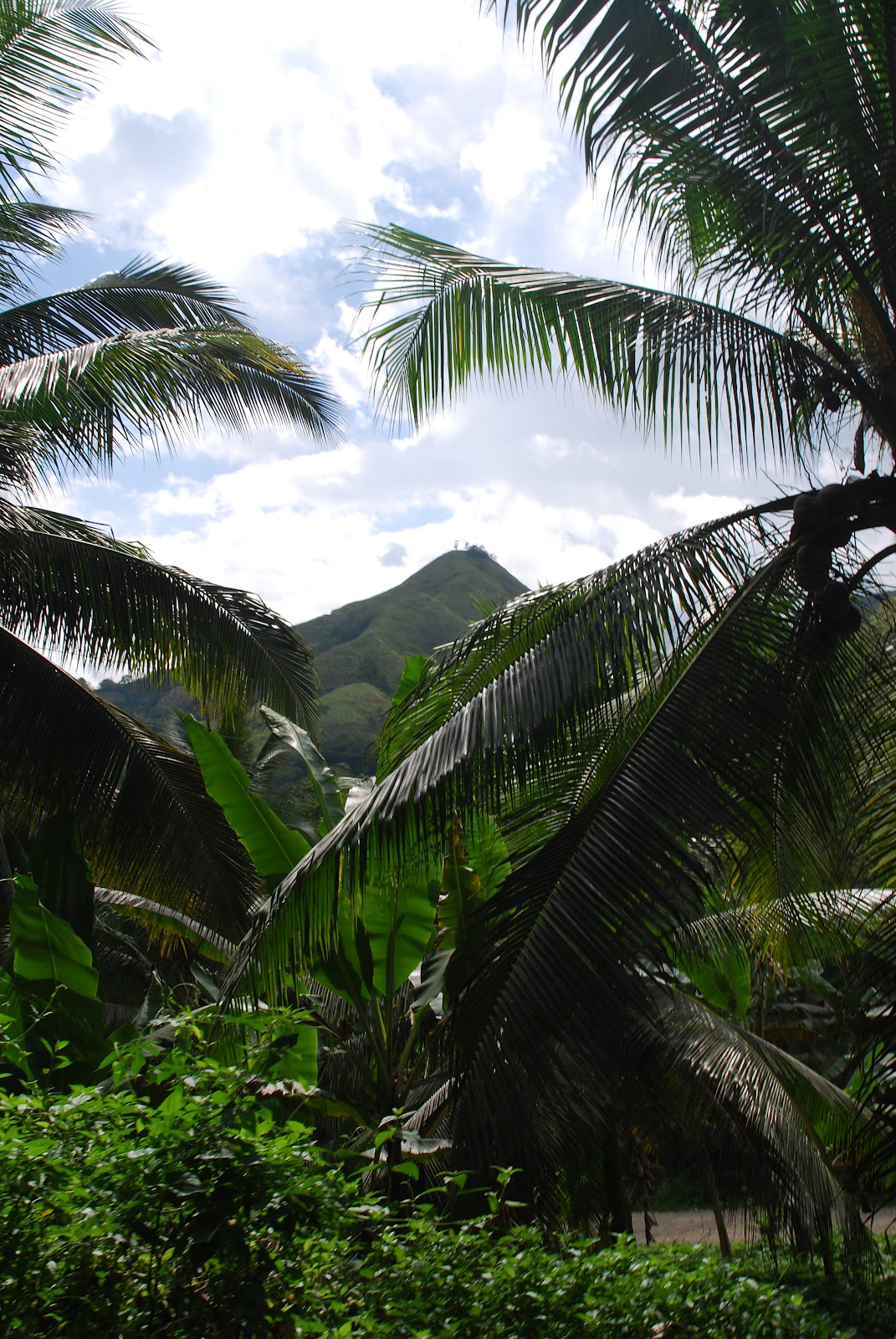
It was a beautiful, if somewhat bumpy, drive.  Banana trees, palms, bamboo and a scattering of domestic beasts (pigs, goats, cows and carabao!) provided the scenery.


Our first stop was a set of tiered waterfalls.  We slipped among the rocks to get a better view of the cascading water that ended in a milky blue pool. The ground was muddy and the rocks slimey, so the flip- flops I wore were a bad choice of footwear.  I should learn from my mother: always wear sensible shoes.


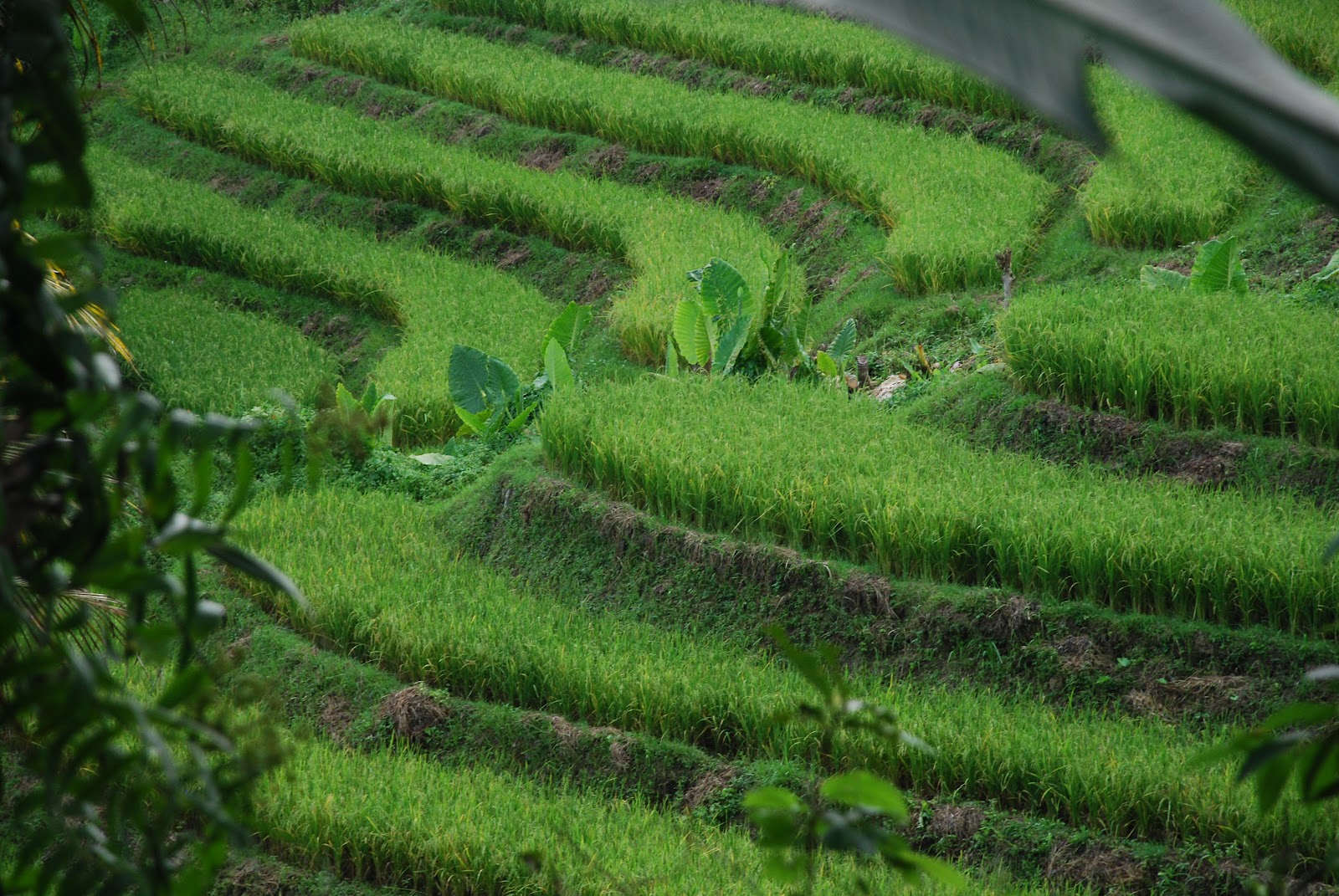
We then took the long road home, stopping periodically to scope out the stunning rice terraces that take advantage of the hilly terrain in the area. The rice shoots are still green right now (apparently they get golden brown later on) and the sculptured steps looked like lush carpet.


 Once the rice is harvested from these fields, it is dried along the side of the road on large tarps.  I can't even imagine how much rice is produced in the entire country seeing how much is cultivated in just this one area. Philippinos love their rice, eating it for every meal of the day.  One of the Filipinas I've met told me she just doesn't feel right if she hasn't had any with her meal, that she will become devoid of energy.  At brekkie, it's often garlic rice and at other times of the day plain.  At the evening food stands near the market, you get sticky rice in bamboo wrappers that you dip in soy sauce with chili.   All good for me though, I have always been a rice fan.  Now, time for dinner.  Rice, anyone?

Monday, 26 March 2012

Friends and Neighbors: Argiope Spider

Time for a confession (deep breath): I am not a huge fan of spiders.  Now, this isn't a very cool thing to admit as a biologist, as we are supposed to think all animals are 'awesome' and show no fear.  Now, don't get me wrong, I don't have out of control arachnophobia.  If I know where they are and they aren't large or hairy or leaping out at me from surprising locations, I am fine with them.  But there are times when I get spider induced heebeegeebees. I blame my Dad (sorry Pere, you are awesome in many ways, but I attribute my dislike of spiders to you).  At some point in my impressionable years, my sister was in her teenage angst phase and moved her bedroom to the basement.  For those of you that know my parents basement, it's not really 'finished' and can, at times, be the denizen of spiders and other such creepy-crawlies.  One morning she schlepped herself upstairs, wearing her housecoat and jammies and was unknowingly accompanied by what I can only describe as a huge-ass wolf spider on her back.  We shrieked, she chucked off her housecoat, and my dad came to investigate what the high-pitched noise was about.  Exhibiting Dad-bravery, he caught the spider in a baseball card case.  Knowing that the case was locked, as a joke (like father's tend to do), he tossed the case (with huge-ass spider inside) towards me.  I lost it- completely terrified.  Now, I could wax philosophical about how society has trained us to hate spiders and how the fear of 'other' has villafied them...but I will spare you. Long story short, spiders = not awesome in my eyes. However, this is my new neighbor and I am ok with it:


Meet an argiope spider.  They are everywhere here.  They are kind of awesome for several reasons.  First, they stay put.  You don't find them creeping around or lurking about places you don't want to see them.  They stay on their web and don't pop out of anywhere unexpectedly (like the creepy huntsmans!).  Secondly, they build a kick-ass web. It's beautiful- I admire their craft. They are an orb spider; apparently this type of spider builds some of the the strongest webs in the spider-world and if undisturbed can last several years!  Thirdly, they exhibit some serious girl power.  The females are huge and powerful, the males are piddly and small (typically 3/4 of an inch to the females inch and a half, see pic above).  Hee hee.  Last, they are stunning.  Really beautiful, don't you agree?


I'll try to introduce you to a few more 'Friends and Neighbors' over the next little bit.  As a teaser, the next edition of FaN will be about the 6 adorable puppies that are currently 20m away (squeeeeeee, puppies!!!!!).